The Profound Half-Truth
When Seeing Half Becomes Blindness Whole

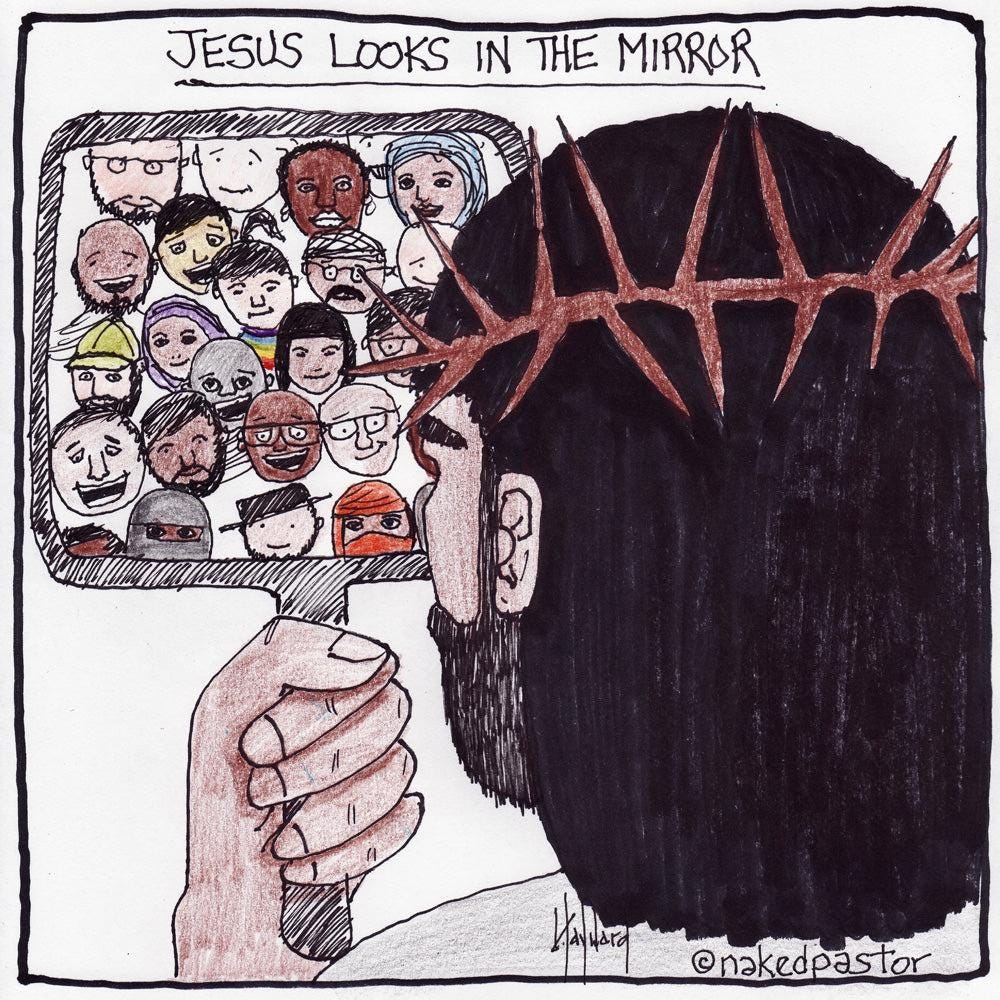
The Me needs the We to Be.
That is not a political slogan. Nor a book title (though it is). It is an ontological claim.
The deepest crisis in American life is not political. It is perceptual.
We are awash in information and starving for vision. We have more data than any civilization in history and less capacity to behold. We can measure almost everything and recognize almost no one. We have learned to see systems without persons, and persons without systems. We have learned to separate what belongs together.
One side sees structures and loses faces. The other sees choices and loses histories.
Both see something real. Neither sees the whole.
There is a kind of error far more dangerous than a lie. A lie can be exposed. A half-truth cannot. The half that is true shields the half that is false, and the whole construction stands there looking like wisdom while quietly doing the work of blindness.
Take almost any issue dividing our common life: homelessness, addiction, immigration, poverty, crime, education.
The Left tends to ask: What happened to this person?
The Right tends to ask: What did this person do?
Both questions matter. Neither question is enough. One sees roots; the other sees fruit. One sees the forest; the other sees the tree.
Neither sees the face.
And once the face disappears, compassion becomes management, justice becomes bureaucracy, and politics becomes a bloody contest between competing abstractions. This is the profound half-truth. It is not destroying us because we disagree. It is destroying us because we no longer see.
I. The Scotoma
Physicians have a word for the blind spot in the visual field: scotoma, from the Greek skotos, meaning darkness.
What makes a scotoma so unnerving is not the blindness itself. It is that you do not know it is there. Where the optic nerve attaches to the retina, sight vanishes. Yet the brain does not perceive a hole. Instead, it quietly counterfeits reality, filling the gap with surrounding information to present a seamless, deceptive picture. The missing piece is replaced by a plausible substitute. You do not see what you are missing; you see a complete world from which something essential has been stolen.
That is the genius — and the terror — of every ideology.
On the left hand, the progressive’s structural analysis operates as a scotoma. It is not wrong. It sees real forces, real systems, real histories, real wounds. It reminds us that suffering has a genealogy, that no life emerges from a vacuum. But every strength casts a shadow. In the very act of seeing structures, the person dissolves upward into circumstance. The individual becomes an instance of a category, a representative of a system, a case study in causation.
On the right hand, the conservative’s moral analysis operates as an identical twin of that same darkness. It is not wrong either. It sees real choices, real consequences, real responsibility. It reminds us that human beings are not merely billiard balls kicked across a felt table by history; we are moral agents whose decisions shape destinies. But this strength, too, has its shadow. In the very act of seeing agency, the person dissolves downward into behavior. The individual becomes an isolated atom, a decision-maker detached from history, abstracted from community.
The ideological scotoma turns windows into mirrors. We do not look through our frameworks to see the reality of the other; we look at our frameworks to see the reflection of our own rightness. The progressive looks at the system to see themselves as the benevolent liberator. The conservative looks at the choice to see themselves as the self-made moral agent. The other is never actually encountered; they are merely the canvas upon which we paint our own righteousness.
Both sides deal in half a human being. And you cannot love half a human being. You can manage them, categorize them, diagnose them, and deploy them — but you cannot love them.
Remove the We, and the Me becomes an abstraction. Remove the Me, and the We becomes a machine.
Here is what this looks like on the ground as I write. Los Angeles Mayor Karen Bass argues that what homeless people need, among other things, is dental care — methamphetamine has destroyed their teeth, and you cannot rebuild a life toothless. She is right.
Spencer Pratt argues that the first order of business is clearing the streets, ending needle programs, stopping the civic normalization of open drug use. He is also right. And yet something in each answer, pursued alone, quietly makes the suffering person disappear — absorbed either into a structural causal chain or into a problem of public order.
In both cases what vanishes is the face.
Bass’s person needs a dentist tonight; Pratt’s street needs order tomorrow. Neither answer is wrong, but pursued in isolation, each behaves like a scotoma. They allow us to clean the street or fill the bed while the actual human being remains entirely unseen—incomplete answers that are, in practice, inadequate to the person standing, or lying, before you.
In Asian cultures, to 'lose face' is to be publicly shamed. But viewed through a literal lens, the phrase becomes the ultimate diagnosis of our modern crisis. Our problem, in two words, is that we are losing face. We have misplaced the actual countenance of our neighbor. By treating the individual as a mere data point for a preferred ideology, we strip them of their unique dignity, blotting the human face entirely out of our vision. If our undoing is summed up in two words—'losing face'—our redemption lies in reclaiming them: we must begin, in every sense of the phrase, saving face.
II. People as Trees Walking
There is a strange, two-stage miracle in the eighth chapter of Mark’s Gospel — the only healing in the New Testament that appears, at first glance, to fail on the first attempt. I have written on this before, because it is so beguiling a story. And every time I write on it I see something new.
Jesus leads a blind man out of Bethsaida. He takes him away from the village, away from the crowd, away from the commentators and the cultural architects. He takes him out of the public square where categories are manufactured.
Then he does something embarrassingly raw, almost scandalous in its proximity: he spits, places his hands upon the man’s eyes, and asks: What do you see?
It is one of the most critical questions in Scripture. Not: What do you think? Not: What is your position? But: What do you see?
The man answers: I see people, but they look like trees, walking.
For years we have read that as a mere optical description of a half-cured eye. But it is something more — a diagnosis of modern civilization. The man is no longer blind, but he does not yet see. He has moved from total darkness to the twilight of data. He sees movement, mass, shapes, silhouettes. He sees consumers walking, voters walking, taxpayers walking, migrants walking, criminals walking. He sees categories in motion. He sees abstractions with pulsebeats.
The tragedy of our culture is not total blindness; it is partial sight mistaken for complete sight. A blind man knows he cannot see. A half-sighted man is tempted to believe he sees it all. We have mastered classification. We know how to count, track, predict, and sort. We no longer know how to behold.
This is why the miracle requires a second movement. The first touch restores perception but only allows the man to navigate — it gives him information, data, the ability to avoid obstacles. It is the second touch that restores personhood, moving him from the cold work of classification to the sacred work of relationship. Between the first touch and the second lies the twilight zone of modern life: we see enough to function, but not enough to love.
Now read the spit.
We are so accustomed to the miracle that we pass over its most theologically charged detail. Why does Jesus spit? The spitting is not incidental. It is, in the deepest semiotic sense, the whole story told in a single gesture — and to read it rightly you have to go back not to Mark’s first chapter but to Genesis’s second.
Then the Lord God formed the human from the dust of the ground. The word for human is adam. The word for ground is adamah. The human is animated earth — scooped clay, fashioned matter, the stuff of the ground given a face. But any potter will tell you what the text implies: you cannot fashion dry clay. The commentators noticed that Genesis 2:6 places a mist rising from the earth immediately before the creation of Adam. The ground is wet when God reaches into it. The elements of the first human are earth, water, and divine breath — clay shaped by wet hands, filled with the neshamah, the breath-blast of God, thereby becoming for the first time a living soul.
Now return to Bethsaida.
Jesus takes the blind man outside the village — into a place of primordial privacy that echoes the intimacy of Genesis 2 — and spits. His saliva is water that has passed through his lungs, moisture carrying the breath of his body, the pneuma of the incarnate Word made liquid and intimate and given. It touches the blind man’s eyes — eyes that are themselves earth, adamah, animated clay. The second Adam meets the son of the first Adam: earth met by water-and-breath, the stuff of the ground touched by the moisture of the divine.
Jesus is not merely performing a healing. He is performing a new Genesis.
He is doing with spit and touch what the Creator did with clay and breath in the garden. The second Adam is remaking the first Adam’s sight using the most intimate, most corporeal, most scandalously incarnational substance possible. Not a word from a safe distance. Not a gesture in the air. Saliva — the wet evidence of his own breathing, his own embodiment, his own refusal to remain at a hygienic remove from the suffering before him.
This is the counter-image to both half-truths. The structural analyst keeps a policy distance — the suffering person is processed through a causal framework that never requires getting close enough to exchange breath. The moral assessor keeps a judgment distance — the suffering person is evaluated through a behavioral framework that never requires getting close enough to be implicated. Jesus closes both distances simultaneously. He gets close enough to spit. Close enough that his breath is on the man’s face. Close enough that the boundary between his body and the blind man’s body is, for a moment, dissolved.
But the semiotics of this liquid proximity are terrifyingly unstable. Spit can heal, or it can defile; it can be an act of primordial blessing, or a gesture of ultimate curse. To understand the gravity of Bethsaida, we must look at its dark, reverse image on the night of the Passion.
In the praetorium, the story is flipped (as one of my doctoral students, Jorge Finlay reminds me). There, it is Jesus who is blindfolded—deliberately blinded by his captors—and then spat upon. The blind world encounters the Face of God, and instead of receiving the second touch, it seeks to defile it. They cover his eyes so they do not have to look at him, and they use their own moisture, their own breath, to curse him. The very substance that remade Adam in the dirt of Bethsaida is weaponized in Jerusalem to degrade the Second Adam. It is the ultimate act of ideological rage: when we are confronted by a Face we cannot manage or categorize, our instinct is to blindfold it and spit on it.
And then — two touches. Because re-creation, like creation, is not instantaneous. It is patient. It involves the creature’s participation: What do you see? The blind man is not a passive recipient of a unilateral miracle. He is a participant in his own new Genesis. His Me matters to the We of the encounter.
Both our half-truths are one touch in — seeing something real, missing the face, confident they have seen enough. What they need, what we all need, is the second touch.
III. The Semiotics of the Face
Every ideology begins with an explanation. Every encounter begins with a face. Explanation asks: What is this? The face asks: Who are you?
To understand the crisis of our age, we must understand the semiotics of the face. In the language of signs, a symbol is always a stand-in for something else. A dollar bill represents wealth; a flag represents a nation; a silhouette represents a category. But a face is a radical semiotic anomaly: it is a sign that refuses to signify anything other than itself.
The moment you turn a face into a signifier for something else — the moment you look at a face and see “the bourgeois,” “the victim,” “the marginalized,” “the migrant,” or “the billionaire” — you have committed an act of semiotic violence. You have stripped the sign of its unique, living substance and turned it into an idol that reflects your own preconceptions.
A face is the ultimate human protest against reduction. It is the human refusal to be summarized. It possesses what the philosopher Emmanuel Levinas called an "excess of meaning"—a surplus of presence that spills over the brim of any taxonomy we try to pour it into. In the semiotic landscape, an ideology functions as an idol—a flat surface that reflects only the biases of its worshiper. But the face functions as an icon. It is a translucent boundary that does not point to a category, but breaks open to reveal a deeper, unrepeatable mystery.
This is why the language of the face runs like a golden thread through the scriptures. The biblical saga is not a history of concepts; it is a drama of faces. Adam is not just animated clay; he is earth given a face. Moses does not ask for an abstract system of ethics on the mountain; he cries, Show me your glory. The Aaronic blessing reaches its symphonic climax in divine visibility: The Lord make his face shine upon you. And when the New Testament reaches its summit, Paul writes that the ultimate, uncreated reality of the universe is made readable to us “in the face of Jesus Christ.”
The story begins with a face sought and ends with a face revealed.
Where an ideological category is efficient, distant, and manageable, the face is demanding, proximate, and mysterious. A category asks for analysis and can be debated in the comfort of a lecture hall; a face asks for a response and can only be met in the vulnerability of proximity.
When the face vanishes, love becomes an impossibility. You can write a policy for a category, allocate a budget for a demographic, but you cannot love an abstraction. Love requires a face because love is the recognition of an irreducible Thou.
This is why Jesus was, and remains, so profoundly disruptive to our political architectures. He consistently looked through the semiotic signage that everyone else found obvious. Others saw a tax collector — a sign of Roman oppression and economic betrayal; Jesus saw Zacchaeus. Others saw a moral failure — a sign of religious pollution; Jesus saw a daughter of Abraham. Others saw a demographic; Jesus saw a name.
Here is where a Christianity centered on the incarnation parts ways decisively with a Christianity reduced to transaction. The Western church, following Anselm’s satisfaction theory of atonement, gradually made the incarnation instrumental — Jesus had to be born so he could die, Bethlehem a staging area for Golgotha. But the Eastern church never made this move. For Athanasius, for Irenaeus, for Maximus the Confessor, the incarnation is not the prelude to salvation — it is salvation, already beginning. God became human so that humans might carry the divine image. Every stage of human existence — including the broken stages, the toothless stages, the stages that end up in encampments — was assumed, indwelt, and dignified by the Word who entered human life entirely. The homeless neighbor, the addict, the prisoner, the victim of violence, the person who has committed violence are not primarily structural problems or moral failures. They are human beings whose full humanity was taken up by the Word, and therefore cannot be reduced to either their circumstances or their choices.
The church has wrestled before with the temptation to reduce a mystery to a single explanation. Chalcedon offered a grammar for preserving complexity without confusion and unity without reduction. In Christ, divinity and humanity are held together without being dissolved into one another. Perhaps the same wisdom is needed in our perception of one another. Human beings are always more than the systems that shaped them and more than the choices they have made. Whenever we absolutize either explanation, we lose the person standing before us. The face disappears into a theory.
I have watched human beings disappear between explanations.
One explanation said they were victims; another said they were perpetrators.
One pointed to history; another pointed to choices.
Both contained a grain of truth, but neither explained the face standing before me. The person remained stubbornly larger than the diagnosis, larger than the failure, larger than the wound.
Every human being is. Because every human being bears the image of a God who exceeds definition. The deepest truth about you is that you are somebody before you are something — a beloved before you are a problem, a mystery before you are a case file, a face before you are a file.
IV. The Stranger Room
If the face is the theological center of Christian perception, hospitality is its architectural expression. The early Christians did not merely preach an alternative worldview; they built a room.
Into the physical layout of the ancient Mediterranean home, they framed a specific space reserved exclusively for the displaced, the traveler, the refugee, the person who did not belong: the xenodocheion — the stranger-room. Long before Christians built cathedrals, they built guest rooms. Long before they drafted creeds, they prepared beds. The architecture was itself a frozen theology. It declared that the stranger was not a threat to be managed or a client to be processed, but a presence to be received. The welcome preceded the explanation; the bed was made before the pedigree was checked.
In the xenodocheion, the semantic boundary between host and guest dissolved. The Latin root hospes carries a beautiful double meaning: it means both the one who welcomes and the one who is welcomed. In the stranger-room, a holy inversion took place: the host became the guest of the stranger’s mystery, and the stranger hosted the hidden presence of Christ.
The Greek word for this practice is philoxenia — love of the stranger. Its antonym is not merely inhospitality. Its antonym is xenophobia. And here is the knife’s edge: both half-truths produce their own form of xenophobia. The progressive’s structural analysis can make the stranger into a category — the unhoused, the marginalized, the vulnerable population — which is a sophisticated form of not-seeing the actual person. You have replaced the face with a file. Bureaucratic xenophobia, well-intentioned and nonetheless real. The conservative’s moral realism makes the stranger into a threat — the encampment, the disorder, the danger — which is xenophobia in its more familiar form. Philoxenia refuses both. It requires you to receive the stranger, which means the stranger has to become, however briefly, not-a-stranger. Named. Fed. Sheltered. Looked at.
This gives teeth to the warning in Hebrews: Do not neglect to show hospitality to strangers, for by doing so some have entertained angels without knowing it. The phrase “without knowing it” is the pivot. It is your scotoma named and reversed.
You thought you knew who was at the door — vagrant, victim, category, case. The text says: your prior vision will cause you to miss who is actually standing there. The stranger may be bearing something from God to you. Your ideological pre-sight is precisely what will prevent you from receiving it. Hospitality is epistemology — the built acknowledgment that the one you receive may have more to give you than you have to give them.
When Christians built these rooms, the rooms coalesced into a network, the network became a movement, and that movement eventually gave birth to the institution we now call the hospital. The modern hospital did not descend from a corporate blueprint or a state directive; it grew from a room built for a stranger’s face.
But what did the modern welfare state do with this inheritance? In its genuine compassion and its genuine pathology, it built the room and removed the relationship. It replaced philoxenia with professionalized management, or bureaucratic clinicalism. It solved the provision problem — shelter, food, services, dental care — while eliminating the personal encounter that was, in the original theological vision, the entire point. You get the roof without the face. The program without the philoxenia. The structure without the Me meeting the We. It is a profound half-truth institutionalized — and it explains why, despite decades of programs and expenditures, the faces on our streets have not disappeared. You cannot love someone into flourishing from the other end of a bureaucratic intake form.
V. The Conversion of the Senses
The recovery of perception is not an intellectual upgrade. It is a conversion of the body.
The gospel does not merely alter our opinions; it recalibrates our senses, moving us along a path of increasing intimacy — from the distance of sight to the proximity of breath.
It begins with the spatial invitation: Come and see. Jesus does not hand the seekers a scroll of propositions. He says, Come and see — inviting them into proximity, close enough that abstractions begin to crack and individual eyes come into focus. But sight can still observe from a safe distance. You can see the encampment, the structural analysis, the behavioral failure, all from a remove that costs you nothing.
So the scripture pushes inward to the gut, to the tongue: Taste and see that the Lord is good. Taste collapses distance entirely. It requires ingestion, participation, vulnerability. You cannot outsource taste; you cannot delegate an appetite. This is why the structural center of Christian worship is not a lecture hall but a table. The Eucharist is truth entering the body before it enters the argument. And it is the body of the other entering yours — the radical mutual reception of the communion meal is the Me and We interpenetrating, each becoming necessary to the other’s nourishment.
Then comes the tactile breakthrough: Touch me and see. The post-resurrection words of Christ to the terrified disciples. Touch is the execution of abstraction. You cannot touch “humanity” in the abstract; you can only touch a singular, scarred wrist. You cannot touch “the unhoused” or “the vagrant” — you can only touch a hand, a shoulder, a face. Jesus touched the leper, whom no one touched. He touched the blind eyes at Bethsaida. He let the hemorrhaging woman reach through the crowd to touch the hem of his garment — and something went out of him, because touch is always a two-way transaction, a mutual reception, a moment in which the distinction between giver and receiver dissolves. The progressive keeps a policy distance. The moral realist keeps a judgment distance. Incarnational hospitality closes the distance entirely.
It gets close enough to touch.
And finally, we arrive at the absolute proximity of the lungs: Breathe and see. We return to the mud of Bethsaida, to the spit, to the pneuma made moisture. Jesus bends over the blind man’s face, replicating the posture of the Creator over the primordial clay, and breathes new sight into the broken apparatus of Adam.
The apologetic of the early church was precisely this — not argument but breath, not proposition but proximity, not a case made but a life given. Tertullian recorded the pagan observation: See how they love one another. Minucius Felix, writing around the same time, records the pagan critic Caecilius watching Christians with genuine unease: they "recognize each other by secret signs and marks, and love one another almost before they know each other."
That was not a doctrinal verdict. It was an aesthetic one. Something was being perceived that the available categories could not explain, and the inexplicability was the apologetic.
Hans Urs von Balthasar argued that the Western church lost beauty first — before it lost truth, before it lost goodness — and the losses of truth and goodness followed necessarily from the first loss. Aesthesis is the Greek word for perception, for the full-bodied, sensory, felt apprehension of the real. Aesthetics is not decoration. It is the discipline of rightly ordered perception. You cannot argue someone into seeing what they have lost the perceptual apparatus to apprehend. You have to show them something that reawakens the capacity for wonder. And wonder is the precondition for genuine encounter with any other, human or divine.
Dostoyevsky’s haunting line — beauty will save the world — is not a sentiment about art. It is a claim about the apologetic power of the incarnation continued in the community that bears Christ’s name. The beautiful, in this radical theological sense, is not the pretty. It is the whole, the real, the fully personal. It is what you see when the scotoma heals and trees become faces.
Francis of Assisi went to lepers. He did not have a theory of leprosy. He had a face he brought close to another face. That proximity — the willingness to be in sensory range of the suffering, the excluded, the frightening — is the apologetic that neither half-truth can generate. And Pentecost is the continuation and the explosion of that same atmospheric shift — the Holy Spirit arriving not as a memo or a policy directive but as a rushing wind that turns isolated Me’s into a living We, breathing new sight into the broken apparatus of a fractured world.
The ultimate apologetics for the church — then and now — is not the making of a rational case. It is the making of a life together that the world cannot explain. Not argument but aesthetics. Not proposition but presence. Not come and hear our case but come and see our life.
Coda: The Balm in Gilead
Our cultural sickness is not an information deficit; it is a perception bankruptcy. We can map the genome and track global markets with dizzying precision, yet we cannot recognize the person across the aisle or across the street. We see trees walking, and we call it political science. Anesthetics has replaced aesthetics.
The balm in Gilead is not a smarter ideology, a more pristine framework, or a more aggressive policy. The balm in Gilead is a second touch.
Where the first touch restores information, the second touch restores relationship. Where the first touch gives us sight to navigate the world of systems and choices, the second touch gives us vision to love within it. The first touch shows us trees; the second touch reveals faces.
The Me needs the We to Be, and the We exists for the flourishing of the Me. Separate them, and our culture becomes either an individualist desert or a totalitarian machine. Hold them together, and the distance begins to close.
A gospel that is not social is not the gospel — the very phrase social gospel is a pleonasm—a redundant phrasing, like speaking of wet water. But the personal and the social, the Me and the We, the individual and the structural, the root and the fruit are conjoined twins. Separate them and both die. The profound half-truth kills what it was meant to save.
Jesus stands before our fractured, data-rich, vision-starved world, bypassing our screens and our platforms, asking the only question that can save us from ourselves:
What do you see?
May we have the courage to drop our mirrors, look out the window, and confess that we have only seen trees—
so that he might touch us again,
until all we see are faces.
**************************
A Reading Life on the Fault Line
I didn’t set out to write about the structural/individual divide. It found me — the way the best theological problems do, not in the library but in the street, in the face of someone I didn’t know how to see correctly.
The first time I encountered the problem with real intellectual force was in seminary reading Reinhold Niebuhr’s classic Moral Man and Immoral Society. I was young enough that the title alone felt like a provocation. Niebuhr’s Christian realism refused every comfortable synthesis — he kept insisting that the same person capable of genuine moral sacrifice in private life could participate, almost unknowingly, in collective brutality. He didn’t resolve the tension. He named it, baptized it, and handed it back to you. That book has never left my thinking.
Neither has his Nature and Destiny of Man, which is where Niebuhr does the deeper theological work — grounding the whole argument in anthropology rather than politics. If Moral Man is the diagnosis, Nature and Destiny is the anatomy. They deserve to be read in that order.
And I should not leave Niebuhr without mentioning the man who read him most carefully and argued with him most productively — Martin Luther King, Jr. King knew this problem from the inside in a way none of the other writers on this list did. He understood structural evil with the clarity of someone who had personally inhabited it, and he understood moral agency with the conviction of someone whose entire movement depended on it. His genius — and I do not use that word lightly — was refusing to let either truth cancel the other. The marches were structural intervention and personal moral witness, simultaneously. The sit-ins were systemic confrontation and individual acts of dignity, inseparably. King's Letter from Birmingham Jail remains, for my money, the single most precise diagnosis of the half-truth problem ever written in the American idiom — a document that holds the white moderate's structural complacency and the black nationalist's despair in the same unflinching gaze, and refuses both. He knew that you cannot love people into freedom from a policy distance. He also knew that personal transfiguration without structural change is just spiritual decoration on a burning building. He paid with his life for refusing to choose.
I’ve been in conversation with James Davison Hunter’s work for years, and two of his books belong on any honest shelf here. The Death of Character is a quiet devastation — Hunter’s account of how moral formation in America collapsed once we severed virtue from community, from tradition, from the We that makes the Me coherent. And To Change the World, which I have often made required reading for my doctoral students, is where he offers his alternative: not the progressive’s structural conquest, not the conservative’s culture war, but what he calls “faithful presence” — embodied, local, institutional, stubbornly incarnational. I don’t agree with everything Hunter concludes, but I have never stopped arguing with him, which is the highest compliment I know how to pay a book.
Robert Bellah and his colleagues gave us Habits of the Heart back in 1985, and it remains one of the most accurate sociological X-rays of the American soul ever taken. I’m not big on sociology (semiotics is better), but Bellah showed how our therapeutic and utilitarian vocabularies had quietly eaten the We hollow — left us with a self that was free, expressive, unencumbered, and entirely unable to explain why it owed anything to anyone. That book is older than some of my readers’ parents, and it reads like it was published last Tuesday.
For the philosophical roots of what I’ve been calling the semiotics of the face, there is no substitute for Emmanuel Levinas — particularly Totality and Infinity. In fact, I did a whole “SoulCafe” newsletter in his honor. Levinas is demanding, dense, worth every page. His argument that the face of the Other is the origin of ethics, that it makes a claim on you before you have time to categorize or explain, is the secular philosophical cousin of everything the incarnation means. And if Levinas is the cousin, Martin Buber’s I and Thou is the grandparent — the original insistence that the I only becomes itself in genuine encounter with a Thou, that the alternative is not independence but impoverishment. Neither of these men is light reading. Both of them will change how you see a stranger’s face.
Charles Taylor’s Sources of the Self is the long genealogy behind the crisis — the story of how the modern self got constructed in a way that made the structural/individual split almost architecturally inevitable. Taylor is patient, massive, brilliant. He takes his time because the problem took centuries to develop. If you want to understand how we got here, Taylor is your guide.
Jonathan Sacks — the late, great Chief Rabbi — wrote The Dignity of Difference with a kind of moral urgency that never tips into hectoring. His argument is simple and devastating: genuine encounter with the stranger, the face that won’t fit your category, is not a threat to your identity. It is the condition of your humanization. The xenodocheion I describe in the essay above — Sacks understood it in his bones. I miss him.
And I’ll confess my own entry in this conversation: Me and We: God’s New Social Gospel, where I first tried to work out theologically what I’ve been pressing further in this essay. Every book is a conversation with the books that came before it and a promissory note to the books that come after. This essay is, among other things, a payment on that note.
Now — your turn.
This list is not a canon. It is a beginning. I know there are voices I’ve missed, arguments I haven’t encountered, books sitting on your shelf right now that belong in this conversation. Who would you add? Which writer first handed you this problem? Which book made you see the trees as faces, or the faces as trees? Tell me in the comments. I’m still learning how to see.
Thank you Len, I wouldn’t be me without you.
Very quickly I’d say the Port William series by Wendell Berry, Christ Plays in Ten Thousand Places by Eugene Peterson and this little known treasure you authored, Strong in the Broken Places. These books among others have helped me see the face of another, and in them see my worst fears, taste my greatest hope, and touch the very core of my becoming — Christ in me becomes present as I witness the presence of Christ in you. For there is no other, except in the funhouse mirrors
I don’t know that I have a book to add, but a thought. Much of my professional research is in driver behavior. The key observation in all of my work is that when we are at a speed and scale that face to face interaction works, then drivers become people again, not just someone manipulating a machine.
The built environment can set the stage for this or ruin it, but it cannot make us see each other. There are two ditches to fall into: too wide open and fast to see anything, or too many around, which makes eye contact feel invasive. It’s the problem that comes when you’re telling little children not to make eye contact in NYC because it’s dangerous.
The physical structure of our world mitigates against seeing and being seen. I like the concept of the stranger room and hope I have a chance to steal it in my next book.