The Family Trade
Why “Blessed are the peacemakers” is the most admired—and most ignored—sentence in the Bible.

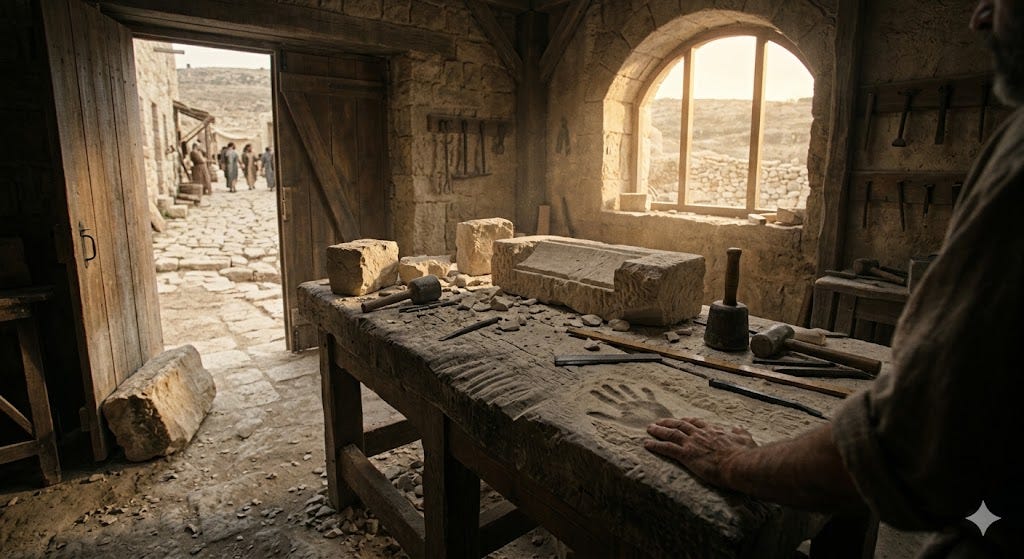
In a world this close to the edge, you would expect “Blessed are the peacemakers” to be the most dangerous sentence in the Bible.
It turns out to be one of the safest.
Everyone nods. Nobody moves. The blessing drifts up over the carnage like a balloon let loose at a graveside — lovely, weightless, floating off to somewhere no one has to reach for it.
That is the trouble with a word that floats. A floater asks nothing of you. You cannot be handed it, cannot drop it, cannot be caught failing to hold it. It just hangs in the air, admired by everyone and gripped by no one.
“Peacemaker” has become a sentiment we all share precisely because it costs none of us anything. And a peace that costs nothing is not the peace Jesus was talking about.
He was talking about a trade.
The Craft of Friction
In the Greek, Matthew does not write eirēnikoi — “the peaceable,” the calm, the even-tempered, the conflict-averse. He writes eirēnopoioi (εἰρηνοποιοί): peace-makers.
That last syllable, -poios, is the maker-stamp that also ends poiētēs — poet, the maker of lines. Jesus does not bless a mood. He blesses a craft.
The peaceable keep peace by keeping their heads down; their gift is mostly an absence — of friction, of noise, of trouble. But you cannot make by not-doing. Making takes material and tools and a bench to lean over, and it leaves behind something that was not in the room before. Jesus blesses the ones who go home with sawdust on their clothes.
And cost is built into the word.
Eirēnopoios appears nowhere else in the New Testament; its cousin the verb surfaces just once more — when Paul says Christ “made peace by the blood of his cross.” The single other place this making turns up, it is bleeding. In Scripture, peace is never found lying around. It is forged, and forged at a price.
So why didn’t we hear any of that? Because English let the word inflate. We turned a tradesman’s title into a temperament, and a temperament floats.
When English Clunks
Which is why, now and then, you have to leave your own language to hear your own gospel. English is a glory, but glories go deaf in the places they know too well.
Listen to Jesus name himself in John’s fourteenth chapter. In English: “I am the Way, the Truth, and the Life.” A serviceable list. Now hear it in Italian: Io sono la Via, la Verità, la Vita.
Three V’s struck like three bells, the vowels thrown open — it does not state the truth, it sings it. English hands you a definition; Italian hands you a melody. And since the One speaking is himself the Word, the music is not decoration. A luminous Christ deserves a luminous sentence. When the English clunks where the Savior shines, the clunk is its own small mistranslation of his beauty.
This is not a failure of translation; it is the whole point of it. At Pentecost the Spirit did not collapse the tongues back into one official language. It spoke the single gospel in many — Parthians and Medes and Elamites, each hearing the wonders of God in the mother tongue they were born crying in.
The gospel was multilingual from its first public breath. So when French hands me les artisans de paix — artisans of peace — and catches the exact weight English had let leak out of “peacemaker,” that is not English failing. That is Pentecost still working. Another tongue, another set of ears, and the floater comes down out of the air and lands in your hands.
The Blueprint of a Tektōn
And artisan is the right word, because it runs straight back to the man saying it. Nazareth knew Jesus as the tektōn (τέκτων, Mark 6:3) — and tektōn is no mild “carpenter.” It is the builder in any hard material, wood or stone, the root that climbs up into our word architect and runs beneath our word tectonic.
Galilee built in stone; he squared more lintels than he turned chair legs. “Carpenter” is the pious shrinkage of a word that meant, simply, the one who builds, the one who crafts art.
Set the two words beside each other and the thing we had stopped seeing stands up: the Artisan is blessing artisans. The beatitude is autobiographical. He is not admiring a virtue from across the street; he is naming his own trade and propping the shop door open.
And here is what the trade demands that the floating word never did: a location.
You cannot be an artisan in the abstract. Every maker is bent over particular material in a particular place — this beam, this stone, this bench. So too the peace.
The Greek eirēnē is carrying the freight of Hebrew shalom, and shalom is never a climate or a mood hanging over the world in general. It is the wholeness of actual relations — this household, this feud, this broken street set right. There is no shalom-in-general. There is only the shalom of some particular tangle you are standing inside of.
Peace, like every other made thing, gets made out of the material in front of you. And the material is your neighbors.
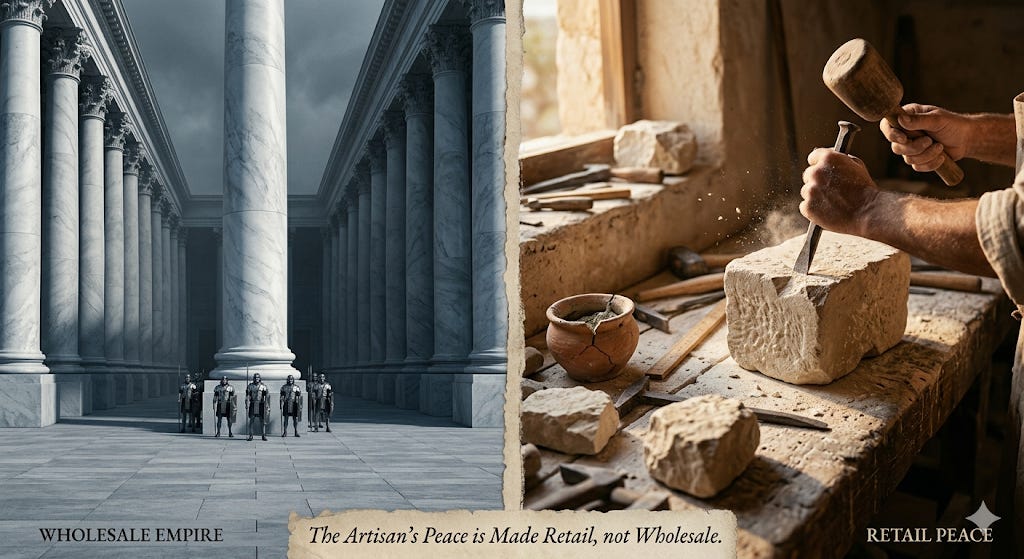
Retail Peace vs. Wholesale Empire
The wider world had another way of making peace — the conqueror’s way. Rome called its boot on the neck of the nations Pax Romana and meant it: peace handed down from the top, wholesale, identical for everyone because no one in particular was ever consulted.
That is peace as a floater too — universal, abstract, imposed from a throne.
Jesus moves the whole operation down to the workbench. Not the emperor pacifying the orbit by decree, but the tradesman mending what is in front of him. The kingdom’s peace is retail, not wholesale. You cannot be an artisan of peace in general. You can only be the artisan of this table, this feud, this fence-line — the peace a body could actually make on a Monday.
It is a shop, then, and not a sentiment — and a shop is where sons are made. In Jesus’s world a son became a son by standing at his father’s elbow until the father’s craft migrated into his own hands. The trade was the inheritance.
So when the line closes — “they shall be called sons/daughters of God” — it is not handing out an honorary title. It is certifying an apprenticeship. You will be known as the Father’s child the way every artisan’s child is known: by the family resemblance in the calluses.
So the blessing was never a balloon to release over the wreckage and watch drift away. It was always a tool, set out on the bench, and a tool blesses only the hand that closes around it.
The tektōn’s children are tektones. Peace is the family trade. In a world this desperate for it, the only question the beatitude has ever asked is whether we will stop admiring it floating up there — and reach.
When you do, you become an artisan of peace. “Blessed are the artisans of peace, for they shall be called sons and daughters of God.”
Lord Jesus,
Master Artisan of Peace,
teach my hands your trade.
Where relationships are splintered,
make me a mender.
Where words have become weapons,
make me a minder.
Where fear has raised its walls,
make me a maker of doors.
Save me from admiring peace from a distance.
Put your tools into my hands.
And in the workbench places of my life—
this table,
this family,
this friendship,
this neighborhood—
teach me to craft the wholeness that bears your name.
Make me an artisan of peace,
that I may be known as a child of the Father,
and carry the family trade into the world.
Amen.
My calluses reveal who my Father is, and seated at His workbench I’m in awe as I learn His peace-making craft! WOW! What a magnificent writing you’ve ‘crafted’ once again, my Artisan Friend! Thank you!! 🙏🏼🙏🏼
I finally have a well reasoned understanding of why I am compelled to conclude all my correspondence with “In peace.” It is my way of endorsing and carrying the family brand/business forward. Thank you.