The "devil’s blinking box," a wrestling scholar, and a confession.
"The Fisherman and the Pharisee:" An Address on the Occasion of the Endowment of the Wayne and Darlene McCown Chair in New Testament Studies, Roberts Wesleyan University, Northeastern Seminary

Dear Friends,
Today, I’m sharing something deeply personal with you. This is the text of an address I recently delivered at Roberts Wesleyan University/Northeastern Seminary for the endowment of a chair named after two people who quite literally saved my faith when I was a rebellious, deconstructing 19-year-old: Wayne and Darlene McCown.
In this piece, I open up about my own family’s wild ecclesiastical history—including the time my mother was defrocked over a wedding ring, bobbed hair, and my father’s “devil’s blinking box”—and explore a tension that sits at the very heart of the Christian life: the tension between the Fisherman and the Pharisee. Between the unlettered heart and the credentialed mind.
Thank you for your generous support of this Substack. Your partnership allows me to dig deep into these stories and share them with the world. I hope this address speaks to your own journey of wrestling with doubt, walking away from “religion,” years of rebellion (I didn’t sow wild oats, I planted a prairie), and what it truly means to sit “with Him.”
Eucharistically yours,
Len
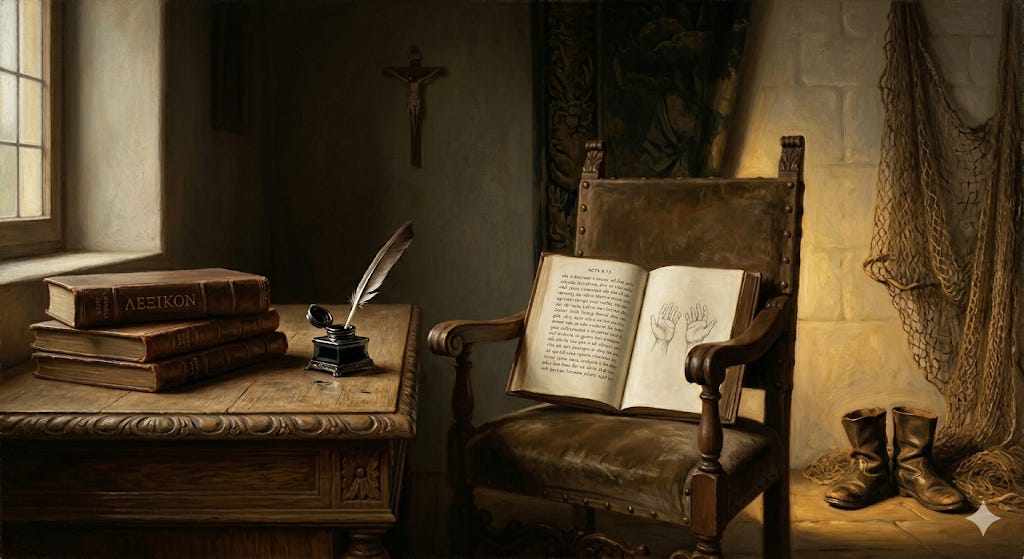
1. AN UNLIKELY ROAD TO RICHMOND
I want to begin with a confession: I am the dumb one of the family.
My brother Phil enrolled at the University of Richmond the year after I did—eighteen months my junior—and became, as the school proudly announced at his graduation, the first student in fifty years of the school’s history never to receive a grade lower than an A. He then went on to get a Ph.D. from the University of Michigan in Germanic studies. My youngest brother John, who is here with me today, went to Haverford, then Princeton Seminary, then earned his Ph.D. at the University of Berlin. Neither Phil nor John seemed to know a “B” existed. I, however, was intimately acquainted with the full alphabet of academic achievement.
We came from a family with no degrees. My Appalachian mother, Mabel Boggs Sweet, never went past the eighth grade. But she had enrolled at a Bible School in Cincinnati—a school of magnificent humility bearing the name “God’s Bible School”—and there she made a friend for life. Her name was Elizabeth (“Bet”) Bray.
Bet worked in Richmond, Virginia, as a supervisor at the Blue Cross Blue Shield. She walked with a severe limp and moved only haltingly, so she offered me room and board if I would drive her for groceries. But there was a codicil to the agreement: her church needed an organist. If I would take the bench, she would bed and board me.
I have no doubt this was a holy conspiracy between my mother and her best friend to rein me in.
My mother was a force of divine nature. She had been ordained in the Pilgrim Holiness Church, then defrocked when she married my Free Methodist father. The charges? She had bobbed her hair, worn a wedding ring, and worn lipstick. She denied the lipstick charge to her dying day—it was the photographer, she insisted, who had enhanced the wedding pictures submitted as evidence at her trial.
She was later ordained as a Free Methodist preacher and evangelist. But that didn’t last long either. Reverend William E. Rudd discovered that the Sweet family had allowed into their home the “devil’s blinking box”—a television.
So, we were removed from church membership. Deacon Rudd extended his ban to our family and to our friends in the congregation. My preacher mom was entirely unperturbed.
“This is God’s church,” she would say, “not man’s church. Man can’t kick you out of God’s church.”
So we kept attending services and camp meetings, even as relatives shunned us. I have written the whole of this story in what turned out to be the hardest book I have ever written among my eighty-plus: the story of my mother, entitled Mother Tongue.
II. THE AIR OF A STUDY ALCOVE
It was while playing organ and piano for that Richmond church that I met a Ph.D. student and his wife: Wayne and Darlene McCown. Wayne, a language genius, was doing doctoral work at Union Seminary. Darlene was getting her doctoral degree in nursing at the same time.
I was nineteen years old. I had deconverted from the Christian faith at age seventeen and was deep in my deconstruction phase—which in those days we simply called “doubt and rebellion,” before it was elevated into a lucrative spiritual memoir genre. But I also wanted to be a scholar more than almost anything else in the world. And Wayne and Darlene McCown did something to me that I did not expect.
They drew me in.
Wayne was a man who knew his Greek and his Hebrew as well as his English. Here was a man doing his dissertation on one of the most theologically demanding, syntactically treacherous, and interpretively contested books in the entire corpus of Scripture—the Letter to the Hebrews. And yet—this was the thing I could not get past—he could still praise and worship God with his whole self. Without apparent embarrassment and without apparent strain.
He took me under his wing. Every time I entered his small, wooded study alcove, the air was different. John Wesley would have recognized it immediately: it was the atmosphere of what he called “knowledge and vital piety.” It was intoxicating to a teenager who had been told by the legalistic churches of his youth that the mind and the heart could not coexist.
Wayne also had a hearty laugh, a quick smile, and some gloriously quirky enthusiasms. I will say only this: when professional wrestling was on television, you did not bother Wayne McCown. I will not go so far as to say he got as excited about wrestling as he did about worship, but it was close.
Through him, I began to see the difference between following the letter of the law and following the Spirit.
We do not follow the letter; we do not follow the lettered. We follow the Spirit.
We do not follow letters. We follow breath.
III. AGRAMMATOS AND GRAMMATEUS
The New Testament gives us a word for what Wayne was not, and a word for what Wayne was. The tension between those two words is the very tension that makes the Christian intellectual tradition possible. The early church didn’t choose between the fisherman and the scholar; it catechized both.
The first word is agrammatos (ah-GRAHM-mah-tos). It appears in Acts 4:13. Peter and John have just healed the lame man at the Beautiful Gate, and the Sanhedrin hauls them in: “Now when they saw the boldness of Peter and John, and perceived that they were uneducated, common men”—literally, “unlettered”—“they were astonished. And they recognized that they had been with Jesus.”
Peter was agrammatos. He had no résumé. His authority was tactile—forged in the smell of charcoal fires, the spray of the Sea of Galilee, and the grip of nets hauled through black water before dawn. When Peter spoke of the resurrection, he was not citing a scroll. He was reporting a breakfast on a beach.
His authority was wound-commissioned, forged between two charcoal fires: one of denial (John 18) and one of restoration (John 21). You cannot silence a person who has touched the wounds. At Emmaus, the opened Scriptures revealed minds—but the broken bread revealed eyes.
The second word is grammateus (grahm-mah-TAY-oos)—the scribe, the scholar, the lettered one.
Enter Paul. If Peter was the heart of the movement’s “what,” Paul was the architect of its “why.” Paul brought the full rigor of Gamaliel’s schoolhouse into every letter. He took the raw, world-altering experience of the Galilean fishermen and translated it into the cosmic, legal, and covenantal language of the ancient world. He could hold his own with the philosophers of Athens and the lawyers of Rome.
But here is the brilliance of Paul: he used his immense literacy to argue for the limits of literacy. His diploma was not discarded; it was counted as loss.
The most credentialed mind in the church declared credentials expendable. The church was born when a fisherman found his voice—and a Pharisee lost his certainty.
The academy trades in proofs. The kingdom trades in wounds.
Acts 4:13 points us to a third category. Not agrammatos, nor grammateus, but met’ autou—”with Him.”
Being with Jesus is the only credential that relativizes every other credential. It is the only knowing that transcends both learning and ignorance. The church was born when the unlettered spoke, the lettered surrendered, and both were recognized by a single mark: They had been with Jesus.
IV. THE OX AND THE UNIVERSITY
I love the story of the founding of Oxford University. It takes its name not from a library or a lecture hall, but from a literal bend in the Thames where oxen could wade across. Ox-ford. One of the greatest intellectual citadels in human history owes its footing to a beast of burden finding the shallow place in the river.
It took an ox to tell the professors where to build their university.
Those spires existed for one purpose: the formation of pastors and theologians—the very vocation that Peter, the unlettered fisherman, had occupied without benefit of a quadrangle. Oxford began as a school for Peters, taught by Pauls.
God has a habit of grounding the grandest human edifices in the humblest origins. The Word became flesh in a feeding trough. The church was built on a fisherman. And the ox didn’t know it was founding a university, just as Peter didn’t know he was founding a church. That may be precisely why both succeeded.
By holding Peter and Paul in tandem, the early church avoided two deaths that have stalked Christian intellectual life ever since:
The death of anti-intellectualism: Had there been only Peter, the faith might have remained a small, local sect of Galilean witnesses—full of warmth, but unable to address the empire or think through the implications of the cross for human history.
The death of Gnosticism: Had there been only Paul, the faith might have evaporated into a heady, abstract philosophy. It would have become a religion of ideas rather than a religion of the Risen One—something you could believe without it ever touching your body, your breakfast, or your beach.
V. A WESLEYAN SYNTHESIS
John Wesley knew this tension from the inside. He was an Oxford don who wore his peruke. He was as grammateus as any man of his century. And yet, in 1739, he wrote words that must have been incredibly costly to a man of his academic formation: he wrote that he had “submitted to be more vile” and stepped off the academic platform into the streets to preach.
Wesley was a grammateus who chose to become agrammatos for the sake of the gospel.
Yet, he never abandoned the library for the field; he brought both. He carried his Greek New Testament on horseback. He held together what so many split apart: the scholarship and the spirit, the mind and the heart.
“Knowledge and vital piety.” That is the charter of every Wesleyan institution. It is a community where learning and formation are so fused that each makes the other more fully itself.
Wayne McCown lived that phrase. I watched him live it in a study alcove barely big enough for a man and his Greek lexicon. His scholarship has been impeccable, and his faith has been holy—not despite each other, but because of each other.
Wayne McCown showed me that the most faithful thing a scholar can do is to keep kneeling, and the most scholarly thing a believer can do is to keep learning.
VI. WHAT A CHAIR IS FOR
Roberts Wesleyan University bears the name of B.T. Roberts, the founder of the Free Methodist Church—the very tradition my family was nearly banned from. Roberts was himself a synthesis: a graduate of Wesleyan University who was utterly on fire. He founded the Free Methodist Church in 1860 over two radical convictions: freedom for the enslaved and freedom in worship for the dispossessed (hence “free pews” or no pew rents) and for women (he published in 1891 what is to this date maybe the best argument for “Why Women Should Be Ordained”). He and his wife Ellen Stowe Roberts were a team. It is so appropriate that this chair is being named to honor another team—"Wayne and Darlene McCown.”
That is the tradition in which this chair is being endowed, and it is the tradition in which the McCowns have spent their life.
A chair in New Testament studies is not merely an academic appointment; it is a statement of belief. It says that rigorous scholarship and living faith are not enemies. It says it is possible to know the Greek and still fall to your knees.
VII. A WORD TO WAYNE
Wayne, I keep coming back to something so simple that I almost didn’t say it: Thank you.
Thank you for being the kind of scholar whose faith made me want to believe again. Thank you for being the kind of disciple whose scholarship made me take the text seriously. Thank you for showing a nineteen-year-old that you cannot have one without losing the other. And thank you for not judging me when I slipped and fell.
When I have watched you—in classrooms, pulpits, and the quieter wrestling of prayer—I have been astonished in the exact same way the Sanhedrin was astonished by Peter and John.
I recognize that you have been with Jesus.
The word inaugural carries a forgotten theology. It comes from the Latin inaugurare—to read the signs, to ask (augur) whether the heavens declare a venture blessed.
I have read the signs of your life, Wayne, and I pronounce this augury over every scholar who will ever sit in this chair:
May you know your Greek—and still kneel.
May you build spires—and remember the ox.
May you fill libraries—and empty your nets.
And may those who encounter you both recognize the only credential that matters: that you have been with Jesus.
Ad maiorem Dei gloriam. To the greater glory of God.
Thank you, Leonard, for this beautifully gripping piece. We come from similar Wesleyan backgrounds.
Len,
Reading these words made me smile at a subtle irony.
In speaking of Wayne McCown, you have also described something of yourself.
You taught us that the early church did not choose between Peter and Paul. It made room for both—the fisherman and the scholar, the witness and the interpreter, the one who touched the wounds and the one who furnished language for what the wounds meant. Yet some rare souls seem to carry traces of both.
The longer I have known you, the more I have come to see that you belong to neither camp exclusively.
For while your scholarship is vast, it has never felt detached from life. Your learning has always borne the scent of Galilean waters. You have never been merely Paul. There is Peter in you as well—a witness beneath the scholar, a disciple beneath the professor, a man who speaks not only from books but from having walked with Christ.
Perhaps that is why so many have been drawn to your work. We encounter not simply a brilliant mind, but a whole life. Your language speaks of the academy, but it has never become your credential. Like the apostles you so often describe, your deepest authority derives from elsewhere.
You have shown generations of readers, students, pastors, and pilgrims that scholarship can kneel and that knowing the text does not withhold the ability to stand astonished before its Author. Few are granted the gift of a teacher. Fewer encounter a mentor. Rarer still is the person who, like the ox at Oxford, can discern the shallow crossing—guiding scholars toward the shoreline and fishermen toward the library, until both find themselves standing in deeper waters.
Thank you for being, for so many of us, both Peter and Paul.