
Eloquence is now under suspicion. The cadence a century of copyeditors trained us toward, the build and turn of the sermon, the aphorism that has been petted until it purrs — all of it has been data-mined, and the machine now writes in the register it studied hardest. Which means the writers and preachers who worked longest at the craft are the likeliest to be accused of never doing the work at all.
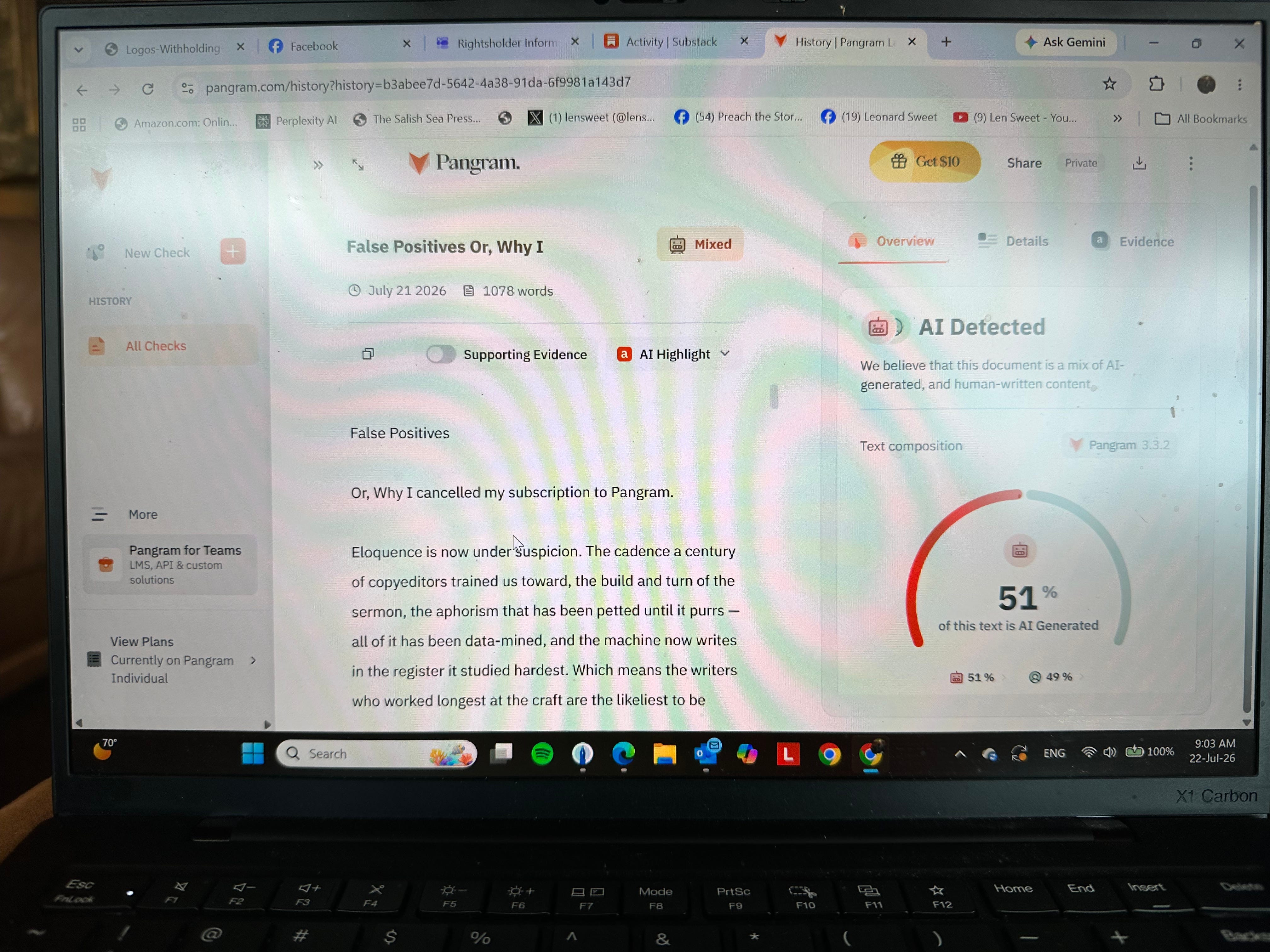
Here’s how I discovered it--with a detector called Pangram. I signed up to “test” my students’ writing to make sure it wasn’t AI generated, since Pangram advertises an exalted “correctness” rate. But before I used it on my students, I used it on myself. I wrote 60 books before LLMs, so why not test out some of my writings?
I played with excerpts from books of 30, 20, and 10 years ago, some of which Pangram rated were 40%, 50%, and 80% generated by AI.
Just yesterday, I submitted a summary and synopsis of my two simultaneously published books to Gemini, to ask for marketing help in promoting both books at once on Substack and on Facebook. Should I do one after the other? Was there any way I could do both at once as an initial announcement? Gemini never read either book, only organized my words and phrases I gave it from the book or I used to describe the book. I asked AI to be my content editor and give me something I could revise and post.
When I did, it was rated by Pangram “100% AI.”
Almost every word and phrase was mine, but rearranged by AI. And the diagnosis “100% AI.”
I have spent my entire writing life “polishing” my writing style. I am also a preacher, so part of my writing style reflects the influence of homiletics, especially the ability of black church preachers to develop litanies that end in a holy hoop and song. I have learned to craft and draft trigger memories through alliterations, and embrace the trinitarian default of three. I also love the Hebraic parallelism and negation moves, which rhetorically have Greek variants like antithesis, epanorthosis, auxesis. Hebraic thought argues by chiastic circling (I call it “throwing curve balls”), restating, intensifying, negating-to-affirm: “Not by might, nor by power, but by...” That “not this, but this” is called litotes in Greek rhetoric but it’s just how the Torah and Prophets think. I especially like epistrophe (as in “of the people, for the people, by the people”).
AI over-learned those moves because it’s everywhere in the training data that is in the public domain.
Here is the irony: The more “smooth” and “polished” your writing, which copyeditors have trained writers toward, the more likely you are to be diagnosed with a false “positive.” The rhetorical inheritance — Cicero’s periods, the King James cadence, the sermon’s build and turn, the aphorism that lands like a pebble rippling in a pond — that whole apparatus of learned eloquence has been data-mined and is now under suspicion.
If you have been formed by that tradition, and write or preach cadenced English on purpose, you are writing in the exact register the machine studied hardest and now imitates. So the preacher and the essayist pay a tax the careless texter or blogger doesn’t. Gemini’s reframing of my words is Midrashic and content editing. The detector can’t tell commentary from creation.
The detector doesn’t measure who wrote it, only what it sounds like — and it was trained to think I sound like the thing that copied me. So preachers, Pangram isn’t catching you sounding like AI. It’s catching AI sounding like you . . . and like Isaiah, and like King James’ translators, and like Gardner Taylor and your own preaching tradition.
The machine was trained on your ancestors and is now being used to accuse you of being the machine. AI learned the deepest habits of biblical rhetoric because biblical rhetoric saturated the corpus on which it was trained.
Now I am learning to write worse on purpose: to rough up the cadence, to be less theologically correct and break the triad, to let a sentence limp and not rip. To not work so lovingly on crafting the perfect aphorism.
To prove I am human, I must now write badly enough to be believed — which is the machine’s last joke, that authenticity has to disguise itself as clumsiness.
To prove I am human I must now become more prophetic.
More like Moses: “I am not eloquent... but I am slow of speech, and of a slow tongue” (Exodus 4:10).
More like Jeremiah: “I cannot speak: for I am a child” (Jeremiah 1:6).
More like Paul, who quoted his critics back to himself: “His letters, say they, are weighty and powerful; but his bodily presence is weak, and his speech contemptible” (2 Corinthians 10:10).
But the last joke is on the machine. It comes from the very book the machine studied hardest.
In 1611, translators of the King James Bible added a long preface called “The Translators to the Reader” (I have cited this treasure trove before). In it they defend exactly what Pangram now punishes. They write that they deliberately refused “an uniformitie of phrasing.” If one Hebrew word could be rendered by three English words, they used all three. They did not want a concordant, mechanical translation. They wanted an eloquent one. Their goal, they said, was not to make the Bible sound like a translation at all. “Translation it is,” they wrote, “that openeth the window, to let in the light.” They polished their English until it sounded pleasing to the ear. Until it sounded, in their beautiful/ugly phrase, like “the language of Canaan... understood even of the very vulgar.”
Seven years they labored to achieve what many preachers spend a lifetime honing and perfecting: a style that is wrought and smooth enough to sound unwrought. An eloquence that sounds like a human talking. Four hundred years later, that ambition is the exact statistical profile of artificial.
The machine was trained on the translators. Now it accuses the translators’ heirs of being the machine.
So, on second thought, I will not learn to write worse on purpose. I will keep the triad. I will keep the holy hoop. I will keep the anaphora. Let the detector learn to read.
Full Disclosure: I submitted this essay to Pangram, and it said that 49% was human, 51% was AI.
A few months ago, I noticed a woman commenting on an author I follow. She uses an obvious pseudonym and writes like an amalgam of Miss Manners, Erma Bombeck and Dean Martin. I loved her comments and found an actual email address for her, sending a lament hoping she could help me think through some things. Her answers, and our subsequent emails, have been amazing. And she writes so beautifully -- ZERO mistakes. (I worked as an editor and proofreader for years and have the red pencils and pica poles to prove it.) I begin to suspect I was having a deeply grounding while also elevating experience with an on-and-off switch. But how to prove it -- or did I even want to? Would she answer truthfully if I asked directly? If she proved to be AI, I would feel bereft. When the Pangram announcement came out today, I thought I would run her next column through it. But now, having read this post, that doesn't appear to be a failsafe option.
This is 1 billionth of 1% of first-world problems. But I really want her to be a flesh-and-blood wise crone rather than electrons scraping wisdom from the take-out containers of the digital universe. Bleah.
I admit that when I saw the Substack announcement of its new venture with Pangram, I attempted to test my own writing. When I was required to create a Pangram account, I refused. Thanks, Len, for confirming what my intuition red-flagged. For writers who work hard to make their content smooth and readable, you have done a great service. Many thanks.